Let's face it. Running a pest control business is already a battle against unwanted critters. The last thing you need is a war against wasted ad dollars, too. As a savvy pest control business owner, you know your marketing budget needs to work as hard as you do. It should reach the prospective customers who are trying to evict their six-legged tenants right now. That's where a Google Ads management company like Cube Creative Design comes in (much like you walk into homes with your spray gun of justice).
We at Cube Creative Design focus on pest control digital marketing. We turn Google Ads into your virtual technician, one that works 24/7 and sends leads to your business. We pick and fine-tune keywords with care, and we build ads and landing pages that convert. Your ad dollars don't get sprayed around like an amateur with a fogger. Our team aims at the right traffic and turns curious searchers into loyal clients who'll call you every time they see something crawling across the kitchen floor. With us running your campaign, you can focus on what you do best: making homes unlivable for pests (but perfectly comfy for humans).
What Are Google Ads, and Why Should Pest Control Companies Care?
Google Ads used to be called Google AdWords. Think of it as the "artist formerly known as Prince" of digital marketing. It's like having your pest control business card show up right when someone's frantically searching "OH GOD THERE'S A SPIDER THE SIZE OF MY FACE WHAT DO I DO?!"
When potential customers type in search terms like "pest control near me" or "help my house is being invaded by ants," Google Ads puts your business at the top of their results. That's prime real estate for catching desperate homeowners in their moment of need. For pest control businesses, it puts your services right in front of people who are hunting for bug-banishing heroes nearby. It's like a billboard that only shows up when someone's actually looking for what you do. Efficiency at its finest.
Google Ads can lift your online visibility in a big way. It reaches more panicked homeowners than ever before, drives more leads, and turns those "ewws" and "ahhs" into booked appointments and revenue.
Why Google Ads Is Your Pest Control Business's New Best Friend
For marketing your pest control business, Google Ads is like the perfect bait in your trap. It draws in exactly what you're after. When you land at the top of search results, your business gets seen faster than termites move into an old wooden house.
Google Ads lets you build custom ads based on specific demographics and search terms. That means you're not wasting money pitching termite services to people searching for rodent control. This kind of precise targeting is like a heat-seeking missile for finding your ideal clients.
But the real beauty? Higher conversion rates. Your ads speak right to the nightmares keeping your potential customers awake (sometimes literally, in the case of bed bugs). They answer the worry that's in front of them today. You're not just selling pest control. You're selling peace of mind to someone who just found mouse droppings in the pantry. When you target people who are looking for fixes to their creepy-crawly problems, you greatly raise the odds of turning desperate searchers into grateful clients.
The Secret Weapons in Google Local Service Ads
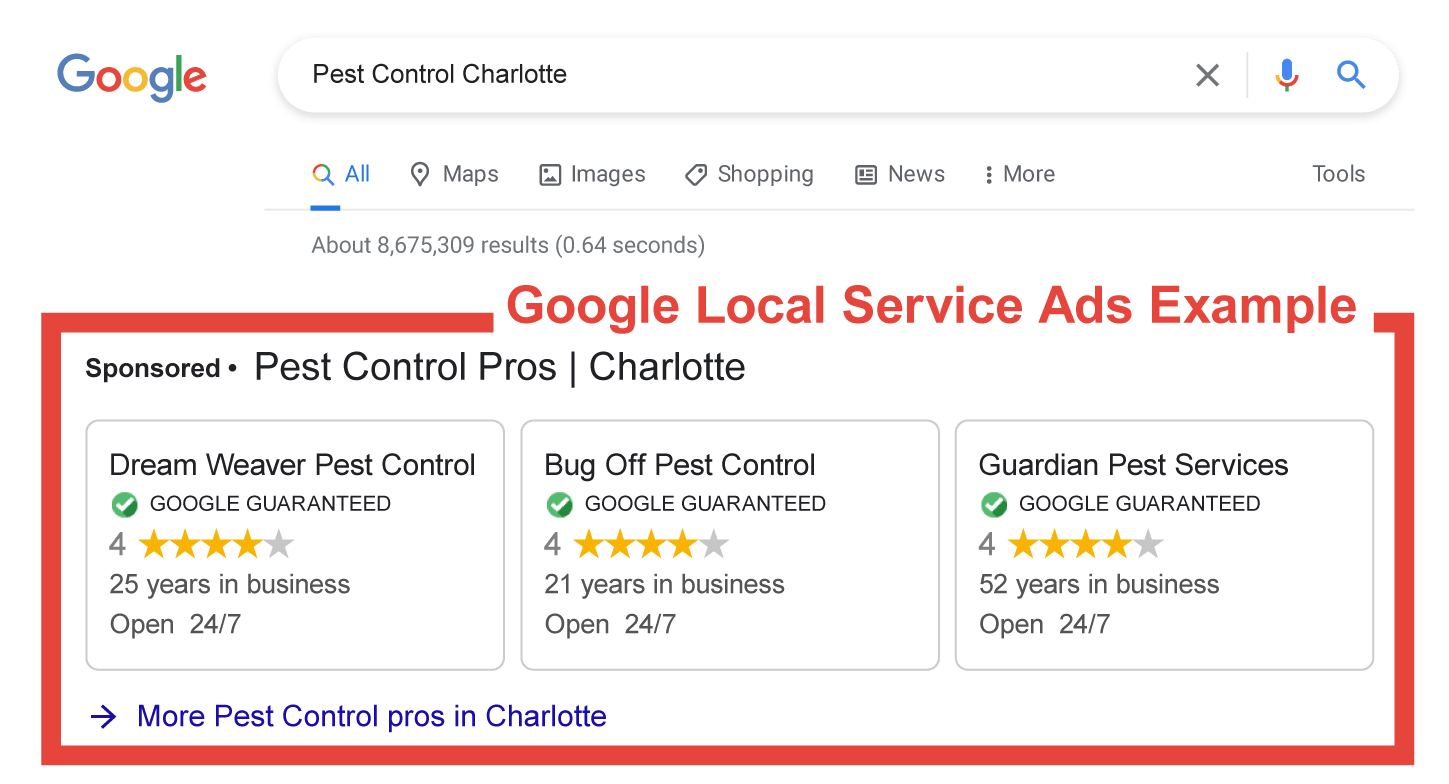
Google Local Service Ads pack more useful features than your favorite pest control toolkit. You pick specific treatments for different pest problems. In the same way, you pick the service types you offer and the service area you cover, and Google shows your ad for those jobs. No more paying for leads from searches for "how to breed exotic beetles" when you want to reach "how to get rid of beetles."
Setting an average weekly budget works like a protective barrier. It keeps your lead costs from swarming out of control, because Google never spends more than your monthly max. Think of your reviews and how fast you answer leads as your business reputation in the digital world. Google weighs both when it decides which Local Services Ads to show. That starts a cycle where visibility and results keep feeding each other.
Your Local Services lead inbox is like setting up monitoring stations around a property. It shows you exactly how well your efforts work, down to each phone call, message, or booking your ad brings in. Meanwhile, narrowing your service areas and service types acts like a repellent. It keeps unwanted leads away so your budget isn't eaten up by jobs that don't fit. Together, these tools build a focused, cost-effective campaign that reaches the right customers at the right time.
Google Local Service Ads deserve special attention in your pest control marketing arsenal. They're like your special gear for really tough infestations. Unlike standard Google Ads, Local Service Ads appear at the very top of search results. They show your business name, phone number, reviews, and the Google Verified badge, which replaced the old "Google Guaranteed" badge. Imagine your truck painted with an official seal that tells homeowners they can trust you before you even arrive.
These ads work differently than standard Google Ads. You pay per lead rather than per click, much like charging customers for the service call rather than just showing up. This model means you're paying for real chances, not just curious browsers. For pest control companies, that matters when emergency calls are your bread and butter.
What makes these so strong for pest control operators is the Google Verified badge. It builds trust with potential customers in an instant. Google basically vouches that your business passed its screening, and your profile shows which checks you passed. (Google dropped the old money-back guarantee when it retired the Google Guaranteed badge.) It's like a referral from the most trusted name in search. For homeowners facing a possible termite infestation or rodent problem, that extra layer of confidence can be the difference between calling you or your competitor.
To qualify, your pest control business must pass Google's screening, which includes background checks and license checks. It's a lot like the thorough inspections you do before a treatment. It takes some effort up front, but the payoff is big: prime placement, more trust, and you pay for leads, not clicks.
Why Your Pest Control Business Needs Google Ads Yesterday
If your pest control business isn't using Google Ads yet, you're setting traps without bait. Google Ads finds potential customers with the precision of a wasp finding that tiny gap in your window screen. It sends people who need your services right to your digital doorstep.
The platform's targeting is like X-ray vision into your market. It lets you reach homeowners in the middle of their pest crises. With daily budget controls and conversion tracking, you're not just spraying money around and hoping it sticks. You're placing smart bets on results you can measure.
Old-school ads are about as targeted as setting off bug bombs in an empty house. Google Ads, on the other hand, gets you seen right when and where it matters, and it brings higher conversion rates. With Google Ads, your pest control business finds its target audience better than a mosquito finds bare skin on a summer evening. The results don't just look good on paper. They turn into real-world growth and new customers.
How Google Ads Actually Works for Pest Control Services
Google Ads runs like a well-designed pest control system: strategic, targeted, and very effective when it's set up right. This digital ad platform shows your pest control services on search results pages and on websites across the internet.
It's built on a pay-per-click (PPC) model. That's like only paying for the traps that actually catch something. You're charged only when your ads get clicks or phone calls. So every dollar works harder than your most dedicated technician.
The platform lets your pest control service zero in on potential clients with specific keywords and location targeting. It filters out the wrong searches faster than your best exclusion work. You set a budget, study conversion rates, and track ad results with tools like conversion tracking and quality score. That way, Google Ads can expand your customer base better than even the most aggressive door-knocking campaign.
Keyword tools also help you find the search terms with the most volume. That way your ads work like your strongest pesticides. They hit exactly what you need to wipe out (in this case, wasted ad spend) and get you the most results.
Expert Google Ads Management With Cube Creative Design
Running Google Ads without expert help is like fighting a termite infestation with a flyswatter. It's technically possible, but why make life harder than it needs to be? With Cube Creative Design, a certified Google Partner, steering your digital ad campaign becomes as smooth as your most routine pest control service.
Our team of campaign managers gets the most out of your ad budget, like expert exterminators finding entry points others miss. We're experts at linking your pest control business with desperate homeowners. They're dealing with everything from ant invasions to zombie-like, tough-as-nails roaches.
Our precise geographic targeting makes sure your ads reach potential clients in your service area, not three counties over where you'd never send a technician. Our approach is as custom as your treatment plans. We build it around your own business goals and budget limits.
When you partner with Cube Creative Design, you're not just handing off ad tasks. You're gaining a strategic edge that saves time and money. It also raises your ROI faster than a colony of termites can damage a foundation. Our seasoned pros stay current on the latest ad trends. They give you sharp analysis so we can keep refining your approach. Choosing us to manage your Google Ads campaign is like upgrading from a handheld sprayer to professional-grade equipment. Suddenly, everything works smoother, better, and more profitably.
The Pros and Cons of Google Ads vs. SEO for Pest Control
Here's the secret to digital ad success for pest control businesses! Learn the pluses and limits of Google Ads and SEO for pest control professionals, and how to combine them for the biggest impact. Let us guide you through the digital jungle and help you attract more customers than ever before!
The Benefits of Google Ads That Make Competitors Nervous
Google Ads is the digital version of a fast-acting pesticide. It delivers results right away, when you need them most. Your customers want pests gone yesterday. In the same way, Google Ads brings a clear jump in traffic almost as soon as your ads are approved.
With targeting precision that would make a sniper jealous, Google Ads lets your campaign reach potential customers by location, demographics, and search terms tied to your pest control services. Say they're searching for "rodent control" or "wasp nest removal." Your ads pop up in front of them faster than ants find picnic leftovers.
Google Ads also gives you budget flexibility that fits seasonal pest patterns. You can spend more during termite swarming season or scale back in slower months. With this pay-per-click model, you only pay when prospects actually engage with your ads. That makes it as efficient as your most systematic treatment plans.
The Downsides of Google Ads That No One Talks About
Let's be honest. Google Ads can sometimes eat your budget faster than termites chew through soft wood. Costs can climb fast, especially if you're up against other pest control businesses with deeper pockets than yours. That's a bigger problem if your budget is tighter than a properly sealed foundation.
The fight for ad space on popular pest control keywords can be fiercer than territorial wasps. That can push your cost per click to eye-watering levels. Google Ads also offers little long-term benefit. Once you stop paying for the campaign, your ads vanish from search results faster than roaches when you flip on the lights. Your visibility drops off a cliff right away.
Why SEO Might Be Your Long-Term Pest Control Solution
Search Engine Optimization (SEO) works like a slow-release pest treatment. It takes time to fully kick in, but it gives you lasting protection. This approach lifts your website's visibility in organic search results over the long haul. It improves rankings for the right keywords, especially local SEO terms that attract customers in your service area.
SEO proves cost-effective in the long run, like preventive pest treatments that save homeowners thousands in damage. Instead of paying for ad space over and over, your spending builds lasting digital equity. A higher spot in organic search results also builds your brand's credibility. It presents your pest control company as the go-to authority. That's the difference between being seen as the neighborhood expert and being just another service provider with a spray can.
The SEO Limitations Every Pest Control Company Should Know
SEO has its own challenges. It takes a lot of time and effort, especially for competitive keywords like "pest control." It's like how a big infestation takes more resources than a simple spot treatment. Google changes its algorithm all the time (it makes more updates than you change your truck's oil). So your control over ranking gains is limited.
Perhaps most frustrating, SEO doesn't deliver results right away. It's a strategy that takes patience, and big gains can take weeks or months to show up. For pest control businesses that need a fast flood of new customers, waiting on SEO can feel like watching paint dry while billing chances scurry past.
How Cube Creative Design Combines Google Ads and SEO for Pest Control Domination
Combining Google Ads and SEO creates a full digital strategy that's greater than the sum of its parts. It's like mixing treatment methods for a fully pest-free space. Google Ads brings in traffic right away while SEO builds long-term results. Together they make a digital ad system that works all year.
Cube Creative Design knows both Google Ads and SEO. We give pest control businesses useful insights and analytics to keep refining their ad strategies. We'll help you find the perfect balance. Ads catch urgent pest control needs, while organic search builds your name as the go-to local expert. This joined-up approach means you catch customers at every stage of their pest control journey.
Creating a Multi-Channel Pest Control Marketing Ecosystem
Google Ads and SEO form the base of your digital pest control marketing strategy. But true domination comes from a joined-up, multi-channel approach. It's like how full pest management works better than one-treatment fixes.
Your Google Ads campaigns produce useful intel that should shape your other marketing channels. The search queries that trigger your ads show exactly how customers describe their pest problems. Mirror those words across all your marketing materials. Say you find that customers in your area search for "carpenter ant damage" rather than "wood-destroying insects." That insight should reshape your social media content, email campaigns, and even your technicians' talking points.
Social media ads work hand in hand with your Google Ads efforts. Google catches active searchers who have pest problems right now. Platforms like Facebook and Instagram build awareness among homeowners who haven't noticed signs of infestation yet. Use your highest-converting Google Ads headlines and descriptions as ideas for social posts. Those posts can teach homeowners the early warning signs of pest issues. That creates demand before they even know they need your services.
Google Ads insights can also make your email marketing much better. Sort your customer list by the pest-specific keywords that brought in their first inquiry. Then send seasonal prevention tips that match their past pest concerns. A customer who found you through termite searches might get spring swarm season warnings. Those who found you through rodent terms get fall prevention tips as temperatures drop.
Even your offline marketing channels gain from this approach. The zip codes with the highest conversion rates in your Google Ads campaigns should guide where you send direct mail or place local print ads. The keywords that drive the most phone calls should shape the headlines on your company vehicles and yard signs.
This system keeps your message the same everywhere customers meet you. It also gets the most out of each channel. The result is a pest control marketing strategy as thorough as your most detailed treatment plans.
Simplify Your Pest Control Digital Marketing with Google Ads Campaigns
Ready to take your business to the next level? A Google Ads campaign can change the game. But let's face it, managing and fine-tuning it can be a real headache. Luckily for you, our simple method is here to save the day! We've built a foolproof process that guarantees your campaign is set up for success, and we keep fine-tuning it for the best results. Here's a sneak peek at our magic formula.
Maximizing Your Digital Campaigns with Search, Display, and Remarketing Ads
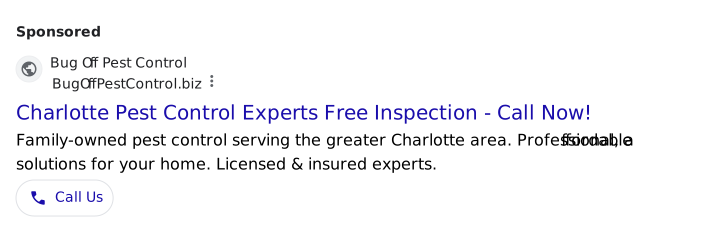
Knowing your target audience matters as much to ad success as naming the right pest species matters to treatment. We study demographics, behaviors, and interests. Then we design strong campaigns built for each ad format. Your message lands whether prospects are actively searching for fixes or just browsing related content.
Search Ads need precision and relevance based on urgent pest queries. Display Ads use visual appeal across websites your potential customers visit often. Meanwhile, Remarketing Ads target people who visited your site before but didn't convert. It's like following up with a customer who noticed pest signs but hasn't booked service yet.
Things like age, family status, and income sharpen our targeting even more. That way your message reaches the homeowners most likely to need professional pest help. Our geo-targeting can also pin down specific zip codes or a radius within your service area. Your ads reach the most relevant audience, and every dollar of your ad budget goes further.
How to Select Killer Keywords That Attract Quality Pest Control Leads
Choosing the right keywords for your pest control Google Ads campaign is like picking the right treatment for an infestation. Use the wrong approach, and you'll waste money with little to show for it. These keywords are what your desperate, itchy customers type into Google when they're frantically searching for fixes to their creepy-crawly problems.
Pick truly relevant keywords, and you'll attract qualified leads rather than curious browsers. You'll raise your ads' quality score (Google's way of rewarding relevance). And you'll stretch your budget by turning clicks into actual service bookings. Start with terms that truly match your pest control specialties and target audience. That might be "emergency wasp nest removal" or "quarterly pest prevention programs."
Then, use Google's keyword planner tool to find high-potential terms in the pest control industry. The sweet spot? Keywords with solid search volume but fair competition levels. Add specific long-tail versions that show high intent (think "how to get rid of bed bugs in apartment" rather than just "bugs").
Setting a Budget That Won't Bug You
Setting the right ad budget for your pest control Google Ads campaign is like planning a full treatment program. It takes strategic thinking and smart use of resources. Start by defining your ideal customer profile. Then look at what your competitors spend to reach them.
Research which keywords potential customers use when they search for pest control services. Then check how stiff the competition is for those terms. It's just like sizing up how bad and how wide an infestation is before you recommend treatment. To avoid overspending, set clear budget limits that fit your business's financial reality and expected return on investment.
Set up solid conversion tracking to see which parts of your campaign bring in actual service bookings. Then you can shift your budget to match. A well-managed campaign lifts your online visibility, like a bait station placed just right to catch the most attention from your target audience. Good budget management keeps your ROI healthy. It makes every dollar count, like a precise application rather than a broadcast spray.
How Cube Creative Design Targets Audiences for Valid Leads
At Cube Creative Design, we know targeting in Google Ads is like precise pest control. The more accurate your application, the better your results. Our team uses smart targeting methods so your message reaches homeowners at exactly the right moment in their pest control journey.
We use hyper-local zip code targeting to outmaneuver your competition. It reaches potential customers in the specific neighborhoods where you want a presence. Our demographic targeting sharpens your campaign by focusing on your ideal audience. That might be established homeowners in the suburbs or property managers of multi-unit buildings.
We also refine your campaigns with interest categories like home improvement or renovation. That targets people in the middle of projects who might find pest issues. Think of it as placing monitoring stations right where pests are likely to travel. It raises the odds of spotting them and acting fast. With our strategic targeting, your pest control ads reach motivated prospects at their moment of need. You get qualified leads, not just a pile of meaningless impressions.
Connecting Google Ads To Conversion Tracking For More Accurate Data
Smart pest control operators know that monitoring is everything, in treatment programs and in marketing. Google Ads conversion tracking is the digital version of monitoring stations. It helps you see exactly how well your campaigns attract real customers rather than curious browsers.
With conversion tracking, you can see exactly how many website visitors take valuable actions after seeing your ads. That might be calling your office, sending a contact form, or booking an inspection. This smart data helps you adjust your campaigns based on actual results. You can double down on what works and drop what doesn't, just like adapting a treatment plan based on inspection results. With conversion tracking set up right, you'll target more potential customers with sharper and sharper precision. You'll also cut wasted ad spend faster than your best treatments wipe out pests.
Proper conversion tracking for your pest control business isn't optional. It's as essential as proper protective gear on the job. Here's how to set it up so you can see clearly how well your campaign works.
First, name the customer actions that matter most to your pest control business. Think phone calls (a must for emergency pest situations), form submissions for inspection requests, finished online bookings, and even time spent on treatment pages. Each one becomes a different "trap" in your digital monitoring system.
Phone call tracking matters most of all for pest control. Most customers with urgent pest problems will call rather than fill out forms. Use Google's call extension and call conversion tracking to record call volume and also call length. That helps you tell quality leads from brief inquiries, much like telling serious infestations from minor pest sightings.
For website conversions, install the Google Ads conversion tracking tag on your site. Think of it as setting up your digital monitoring system. Create separate conversion actions for different form submissions (residential vs. commercial requests, for example). Then give each one a value based on your average service ticket size.
Most importantly, use this data to guide your bidding strategy and budget. Some keywords or ad groups may bring in more phone calls from customers describing emergencies (your highest-value leads). Move budget to them from weaker segments, just as you'd send your technicians to the most pressing infestations first. This closed-loop system makes every dollar of your pest control marketing budget work as hard as your most dedicated technician.
Why Quality Score Matters More Than Most Pest Control Companies Realize
Quality Score is Google's grading system for your ads, keywords, and landing pages. Think of it as your online reputation score, but it's one that directly affects your ad costs and results. Higher scores mean better performance, much like how your customer reviews sway potential clients' decisions.
Google bases Quality Score on three parts: expected click-through rate, ad relevance, and the experience users have on your landing pages after they click your ads. Each part is compared with other advertisers whose ads showed for the same search over the last 90 days. The ad quality behind a high score brings lots of perks: better ad positions, lower costs per click, more relevant traffic, and more chances to convert.
Most local pest control operators work with tight marketing budgets. For them, improving Quality Score isn't just helpful. It's essential for campaign success. Google says higher quality ads typically cost less per click. So a low score can mean paying more for the same clicks and showing up lower on the page. Smart campaign management keeps raising this metric with relevant ad content, better landing pages, and strategic keyword choices.
Let's get technical about Quality Score, because knowing the details can save your pest control business thousands in wasted ad spend. It's like knowing exactly which treatment plan will wipe out a specific pest fastest.
Google rates Quality Score on a scale of 1-10 for each keyword. The score itself isn't used in the ad auction. It's a diagnostic that shows how your ad quality compares with other advertisers, and that ad quality does affect what you pay. For competitive pest control terms like "emergency exterminator" or "termite treatment," better ad quality can mean a lower price for every click.
Three specific factors shape your score. Google doesn't publish how much each one counts.
- Expected Click-Through Rate: How likely users are to click your ad when it appears for your chosen keywords. Improve this by crafting compelling ad copy that speaks directly to pest emergencies and specific treatment needs.
- Ad Relevance: How closely your ad matches the user's search intent. Create separate ad groups for different pest services (rodent control, termite treatment, general pest management) rather than using one generic pest control ad.
- Landing Page Experience: How relevant and useful your landing page is to someone who clicks your ad. Create dedicated landing pages for specific pest services. Your termite ad should link to your termite treatment page, not your general services page, just as you wouldn't use the same treatment for every pest situation.
Google gives you Quality Score feedback for each part in the keywords section of your Google Ads account. Look for "below average" ratings in any category and fix them right away. They're like red flags in a pest inspection that need attention now. For pest control businesses in competitive markets, aim for Quality Scores of 7 or above. Better ad quality typically means you pay less per click than less-tuned competitors.
How to Use Search Volume And Queries To Exterminate Wasted Ad Spend
Expanding your pest control company's online presence takes smart use of search volume data and query analysis. It's like studying pest activity patterns before you build a treatment plan. Start by picking the right keywords with tools like Google Keyword Planner. Find terms that fit your services, target audience, and service areas.
Long-tail keywords (like "emergency wasp nest removal near me" rather than just "pest control") drive highly relevant traffic that's more likely to convert. These specific phrases may have lower search volume, but their intent is much clearer. These searchers need help now, not just information.
Match your ads to search queries by working target keywords into your headlines and descriptions. That raises your quality score and lines up with user intent. This approach attracts potential customers who are actively looking for pest control help. It lifts ROI because your marketing dollars go to truly interested prospects rather than casual researchers or DIY fans.
Mastering search volume means knowing the seasonal rhythms of pest control searches. It's like knowing when different pest populations usually surge. Tools like Google Trends alongside Keyword Planner show key seasonal patterns. Termite searches spike in spring swarming season, rodent searches rise as temperatures drop in fall, and general pest searches climb in the summer months.
Smart pest control operators build their keyword strategies around these steady cycles. They raise bids and budgets for termite terms in April-May, mosquito terms in summer months, and rodent terms in October-November. It mirrors how you might shift your technician schedule around seasonal pest pressure.
Digging through search query reports takes detective skills, just like a thorough pest inspection. Look past the obvious terms for patterns in how customers describe their own situations. You might find surprise terms like "scratching in walls at night" (likely rodents) or "small dirt tubes on the foundation" (termites). These searches show how homeowners see pest problems before they know what's causing them. They're golden chances to reach customers earlier in their pest control journey.
Competitor keyword research gives you another strategic edge. Tools like SEMrush or SpyFu can show which keywords your successful competitors target and roughly what they're paying per click. This intel helps you spot profitable keyword chances or gaps in the market. Maybe they're dominating termite terms but ignoring bed bug searches. That leaves an opening for your business to build expertise in that niche.
Most importantly, learn the search patterns unique to your service area. Urban pest control searches often focus on apartment treatments, while suburban areas bring more prevention and perimeter control queries. Rural areas might show higher volume for wildlife and farm pests. These local differences should shape both your keyword choices and your ad messages. That keeps your campaign as targeted as your most precise spot treatments.
Understanding Cost-Per-Click: The Metric That Makes or Breaks Your Campaign
Watching your average cost-per-click (CPC) is essential for pest control businesses using Google Ads. It's the digital version of tracking your cost per lead or service call. This metric is what you pay each time a prospect clicks your ad, and it directly affects your campaign's profitability.
When you track CPC closely, you'll manage your ad budget well and spot high-performing keywords that may cost a lot. Keeping CPC reasonable gets you the most clicks and conversions within your budget. It's like how smart routing gets the most productive time out of your technicians between service calls.
A few factors shape your average CPC. One is keyword competition (terms like "emergency pest control" usually cost more than "quarterly pest inspection"). Another is your quality score. More competition drives CPCs higher, especially during peak pest seasons. Higher quality scores can cut your costs a lot, rewarding relevant, well-built campaigns with cheaper clicks.
Ongoing monitoring and fine-tuning are a must. Test different keywords, ad versions, and bidding strategies to find the most cost-effective approach. The gains to your ROI might be the difference between a campaign that barely breaks even and one that delivers steady, profitable growth for your pest control company.
How Zip-Code Targeting Helps You Dominate Your Service Area
To supercharge your pest control Google Ads campaigns, use zip code targeting. It works like a precise treatment application, focusing your resources right where they'll have the most impact. When you select specific zip codes, your ads only show to potential customers inside your service areas. That cuts wasted impressions and clicks from places where you don't send technicians.
Setting up this targeting is simple. Go to the "Locations" section in your Google Ads settings and use the "Advanced Search" feature to enter your zip codes. This focus makes your ad budget work harder. It reaches homeowners and businesses who can actually book your services rather than people outside your range.
The result? Higher conversion rates and lower cost per acquisition. Your campaign targets prospects who can really become customers, which leads to better ROI and lasting growth for your pest control business. In competitive markets, this local precision might be your biggest edge over less savvy competitors.
The Negative Keywords Strategy That Saves Pest Control Companies Thousands
Negative keywords are the unsung heroes of Google Ads campaigns for pest control businesses on tight budgets. They work like exclusion methods in pest management. They keep unwanted things out and let the good ones in. When you filter out the wrong traffic, you save budget and raise conversion rates. Your money goes to truly qualified leads.
To find good negative keywords, list search terms that have nothing to do with your pest control business. These include services you don't offer ("beekeeping supplies"), places outside your service area, or technical terms that draw researchers rather than customers. Common examples include "DIY pest control," "pest control jobs," "pest control equipment," or "pest control courses." People use these terms when they want information, not services.
In competitive markets, think about adding competitors' business names as negative keywords. That avoids clicks from people searching for them by name. This approach makes sure your ad spend targets people looking for your services. It gets the most from your budget and your campaign. That's the difference between a profitable campaign and one that drains money without a decent return.
A/B Testing: The Scientific Method Applied to Pest Control Marketing
A/B testing functions as the test method for improving Google Ads campaigns. It's like testing different treatment approaches to find the best fix for a stubborn pest problem. This step-by-step process compares two ad versions that differ in one variable. Then it shows which one does better at bringing in clicks, leads, and conversions.
To run a good A/B test, pick one element to test, such as your headline approach or call-to-action wording. Create two versions of your ad that are the same in every other way. Launch both at the same time for a set period. Then compare results, focusing on click-through rates and conversion numbers to find the winner.
For the biggest impact, define your target audience with precision and pick relevant keywords that match their search intent. Test one variable at a time so the results are clear and useful. Track outcomes closely with conversion tracking and Google Analytics. What you learn should shape your ads and maybe your overall marketing message too. It helps you build language that clicks with customers on every channel. A steady follow-up routine makes sure you make the most of the leads you get. It turns clicks into service appointments as smoothly as your best technicians work.
How Cube Creative Design Tunes Campaign Data For Better ROI
Cube Creative Design approaches campaign tuning the way pro pest inspectors approach a property: with careful attention to detail and data-driven insight. Our skill in audience targeting, keyword selection, and budget planning isn't based on guesswork. It's backed by full analytics and performance metrics.
We use smart tools like Google Analytics to find your top ads, place your ad spend wisely, and set up negative keywords with care. That cuts wasted clicks and gets the most out of the good ones. Our step-by-step A/B testing builds better and better ads for your pest control business. We refine messages and offers based on how customers actually respond, not on guesses.
With Cube Creative Design managing your Google Ads campaign, you gain real confidence. Every part of your digital marketing gets tuned again and again for the best ROI. We don't just run your campaigns. We keep improving them, with real results that turn straight into service bookings and revenue growth for your pest control business.
Our tuning process runs on a set schedule. Weekly, monthly, and quarterly reviews each look at a different part of campaign performance. It's like how you might set up regular pest monitoring for commercial clients.
Weekly tune-ups focus on the key metrics that need attention right away:
- Cost per conversion by ad group: Identifying which pest-specific ad groups are delivering the most cost-effective leads
- Quality Score changes: Addressing any sudden declines that might indicate relevance issues
- Geographic performance variations: Adjusting bids for zip codes showing higher conversion rates
- Search query analysis: Adding new negative keywords to filter out non-converting traffic
Monthly reviews dig deeper into bigger performance patterns:
- Device performance: Optimizing for the devices your customers use most (often mobile for emergency pest situations)
- Day and time analysis: Adjusting bid schedules to increase visibility during high-conversion periods
- Demographic insights: Refining audience targeting based on conversion data
- Ad copy performance: Replacing underperforming ad variations with optimized messaging
Quarterly strategic assessments examine:
- Seasonal trend preparation: Adjusting budgets and focus in anticipation of pest-specific seasonal patterns
- Landing page conversion rate optimization: Enhancing page elements based on heat mapping and user behavior
- Competitor position analysis: Adapting strategy based on competitive market changes
- ROAS (Return On Ad Spend) assessment: Calculating true return by connecting ad costs to actual service revenue
This careful approach makes sure every part of your campaign gets the right attention at the right time. It's like how regular property treatments get much better results than random ones.
Our pest control clients really value our custom reporting dashboard, which turns complex campaign data into clear next steps. Rather than burying you in technical metrics, we focus on business results. Those include cost per new customer acquired, the most profitable service types from ad-generated leads, and revenue tied to specific campaign elements. This practical approach means you always know exactly how your ad spend turns into business growth.
Use Cube Creative Design to Exterminate Your Marketing Problems
Cube Creative Design helps pest control businesses turn their Google Ads campaigns from money pits into lead machines. With our skill in PPC and SEO, we bring in high-quality leads for both residential and commercial pest control services. Our full process covers finding your target audience, picking relevant keywords, setting the right budget, and building strong ads and landing pages.
We use advanced strategies like zip code targeting, negative keyword selection, A/B testing, and data-driven campaign tuning to get the most out of your ads. When you partner with Cube Creative Design, you can expand your online presence and reach potential clients in a targeted, cost-effective way. Get the benefits of Google Ads for your pest control business by contacting me today.
Google Ads For Pest Controllers FAQs
Got more questions? Check out our common questions below. If you still want more answers, book a consultation today!
I'm Curious, What Sets Cube Creative Design's Google Ads for Pest Controller Service Apart From Other Digital Marketing Agencies?
At Cube Creative Design, we know that pest control marketing needs a special touch. Our team is made up of experts who focus on pest control businesses. We build Google Search Ads that use a broad mix of keywords, from exact match to phrase match options. With our know-how, we can help you get high-quality leads for your pest control business.
What's the Cost of Cube Creative Design's Google Ads for Pest Controllers Service?
We set the cost of our pest control services based on your marketing budget, business goals, and monthly budget. Our flexibility lets us create a plan that fits your finances and goals. We're here to help you reach your goals within your budget.
What's the Typical Timeframe for Seeing Results With Cube Creative Design's Google Ads for Pest Controllers Service?
Timing and competition can affect results. But we usually see more customer calls and pest control leads within the first month of starting your Google Ads and Google Local Services Ads campaigns.
Can You Please Explain to Me How Much I Should Be Actively Participating in the Process?
We take care of everything, from building Google Search Ads to setting up extensions like Location and Callout. Our priority is transparency. We keep you updated with data on clicks, impressions, conversion rates, and customer reviews.
Is It Possible to Target Specific Areas With Cube Creative Design's Google Ads for Pest Controllers Service?
To make sure your ads reach your ideal customers in the areas you serve, we use Google Ads location targeting, Google Maps, and your Google Business Profile.
I'm Excited to Learn More About Cube Creative Design's Google Ads for Pest Controllers Service. Can You Walk Me Through How to Get Started?
We're here to help you get started! Just fill out our Contact Form with your contact details or send us an email directly. From there, we'll set up a consultation to talk about your business, your job types, and your ad goals.
I'm Interested in Possibly Creating a Website for My Pest Control Business. Can Cube Creative Design Assist Me With This?
We're happy to tell you that we don't just provide Google Ads services. We also offer web design to create a stunning website for your business. It includes a contact form to make it easier for customers to reach you.
Will I Be Able to Access Data and Analytics for My Campaign?
Yes, we share campaign performance data with you on a regular basis. That includes analytics from your Google Business Profile, so you can stay up to date on your campaign's progress.
Is It Possible to Modify My Campaign Once It Has Been Launched?
We completely understand that business goals may change over time. Don't worry, I'm here to help. I'll work closely with you to adjust and improve your campaign so it always meets your goals.