Let's face it. Most private schools are great at teaching but oddly awkward when they talk to prospective parents. As if reaching out to potential customers (yes, that's what they are) takes some ancient ritual only the admissions team knows. The truth? A smart parent communication timeline is the difference between a full enrollment funnel and watching families ghost you faster than a middle schooler dodging homework.
Families who are thinking about private school usually interact with a school many times before they make an enrollment decision. Yet many schools run on a communication plan that boils down to "respond when contacted" and "send that one email we wrote in 2017." Not exactly a recipe for success when the race for families is this tight.
This guide breaks down the key parts of a parent communication timeline that works. It runs from first awareness to the final decision, with real steps any private school can use. Let's turn your parent outreach from random acts of communication into a real enrollment driver.
What Are the Five Essential Communication Phases in the Private School Enrollment Journey?
The parent journey from "vaguely interested" to "enthusiastically enrolled" follows a pattern you can predict. When you map your communications to these phases, families get a smooth path that builds their trust in your school.
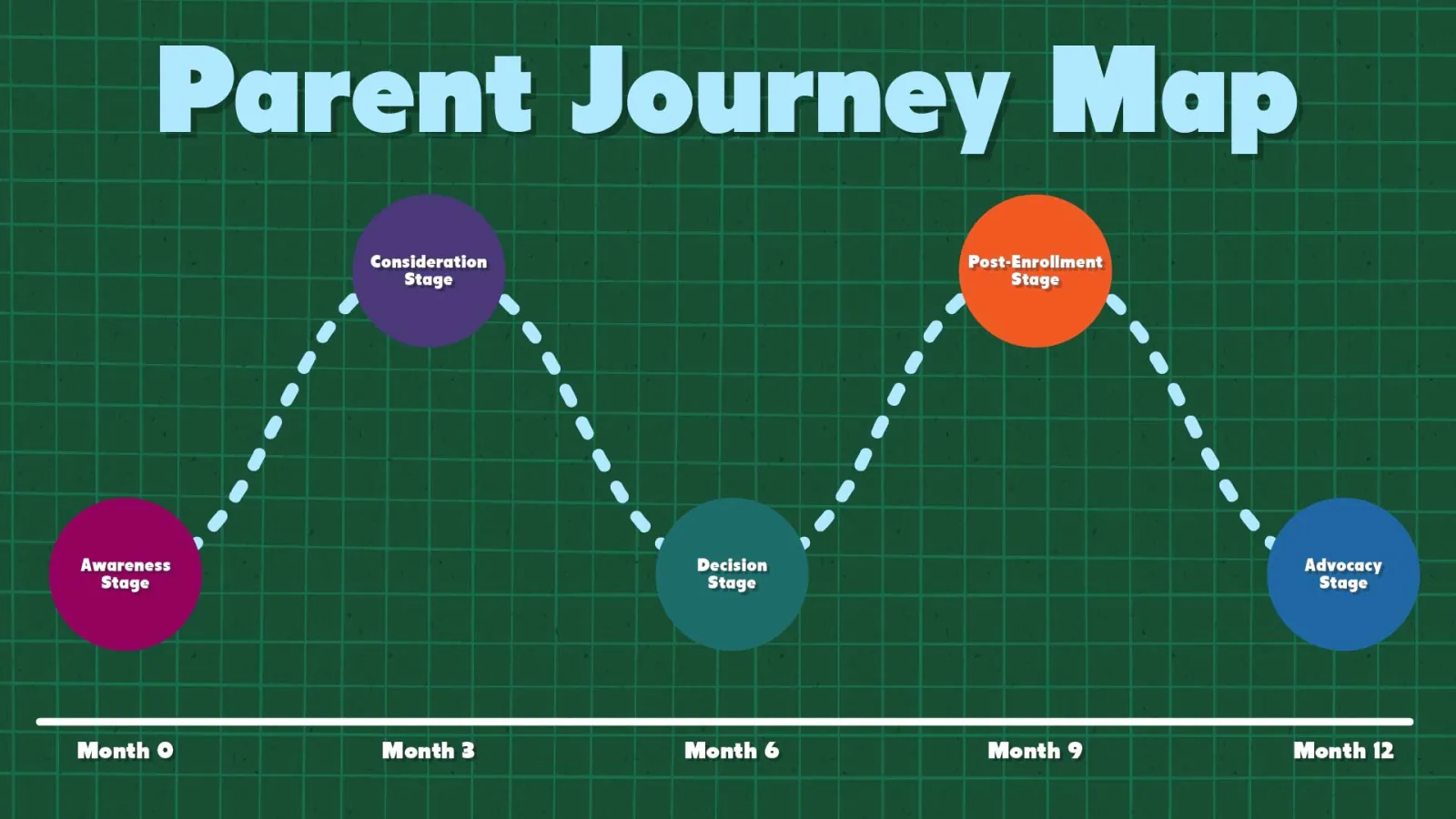
Phase 1: Initial Awareness (3-6 Months Pre-Application)
The awareness phase starts the moment a family first comes across your school. That might be a Google search, a social media post, or word from another parent. This key stretch calls for communications that do the following.
- Establish your school's unique value proposition
- Differentiate from other educational options
- Address preliminary questions and concerns
- Create an emotional connection to your community
Timing tips: Awareness communications should show up all year long but ramp up 3-6 months before your application period opens. This gives families time to weigh their options while your school stays on their short list.
Content approach: Keep these communications short, visual, and focused on what makes your school stand out. This isn't the time for detailed curriculum breakdowns. It's about a first impression that makes families want to learn more.
Phase 2: Information Sharing (2-4 Months Pre-Application)
Once a family has shown interest, they enter the information-gathering phase. They're weighing options, digging into details, and trying to picture their child in your community. Here's what your communications should do.
- Provide detailed information about programs and offerings
- Showcase student experiences and outcomes
- Highlight faculty expertise and teaching philosophy
- Answer common questions before they're asked
Timing tips: Focus these communications in the 2-4 month window before applications open. This lets families take in the details while your application deadline adds a natural push.
Content approach: Pair full detail with formats that are easy to take in. This is where virtual tours, in-depth program guides, and faculty profiles shine. Parents are likely looking at several schools at once. Clear, tidy content wins.
Phase 3: Decision Support (1-2 Months Pre-Application)
As application deadlines get close, families need communications that help them make confident choices. Here's what those messages should do.
- Address common hesitations and objections
- Provide clear comparisons with other educational options
- Offer personalized information based on specific interests
- Create opportunities for direct conversation with current community members
Timing tips: Step up decision support communications 1-2 months before application deadlines, when families are making their final picks.
Content approach: This is the time for more personal, direct communication. Webinars on key topics, small group Q&A sessions, and chances to talk with current parents are worth their weight in gold.
Phase 4: Application Guidance (Application Period)
Once families start applying, your communications shift to hands-on guidance through the process. These messages should do the following.
- Provide clear instructions and deadlines
- Offer support for common application challenges
- Maintain enthusiasm while setting realistic expectations
- Keep applicants engaged throughout the review period
Timing tips: These communications must match your application timeline closely. Watch the days right before deadlines, when most families finally hit submit.
Content approach: Clear beats clever in application guidance. Skip the cute lines and give plain directions. Families often quit applications when they get confused, so work hard to make this phase smooth.
Phase 5: Follow-up Sequences (Post-Application)
After applications are in, many schools make the big mistake of communication silence. This phase calls for thoughtful messages.
- Acknowledge receipt and express appreciation
- Set expectations for next steps and timing
- Maintain connection during the evaluation period
- Prepare families for both acceptance and non-acceptance outcomes
Timing tips: Plan communications across your review period, with extra care for the wait right before decisions go out.
Content approach: These communications build trust in your process while they ease worry. They should sound like your school, with polish and respect for all the family has put into the process.
How Should Private Schools Choose Their Communication Channels?
The channel strategy for your parent communications timeline decides whether your carefully crafted messages reach families. It also decides whether they land. Let's look at the best approach for each communication channel.
Email Sequences: The Backbone of Your Strategy
Email is still the most flexible communication channel for private school enrollment, and the easiest to track. Good email sequences should do the following.
- Segment audiences based on interest level, child age, and specific program interest
- Automate timely follow-ups without sacrificing personalization
- Balance useful information with chances for families to engage
- Track open and click rates to continuously optimize content
Implementation tip: Create email templates for each phase of the communication timeline, then tailor them to each family's interests. A parent who came to your STEM open house should get different content than one who asked about your arts program.
Text Messaging: The High-Priority Channel
Most people read a text soon after it arrives, while email often sits unread. That's why texts deserve a real spot in your communication plan. Save texts for these uses.
- Time-sensitive reminders and deadlines
- Event confirmations and updates
- Brief, actionable requests
- Messages requiring immediate attention
Implementation tip: Always get clear permission before you send texts. Then limit how often you send them so they stay high priority. Nothing will get your number blocked faster than daily texts about cafeteria menu changes.
Social Media Updates: The Community Builder
Social platforms give you rare chances to show off your school culture while you reach new families. Effective social media in the enrollment timeline:
- Creates "windows" into daily school life
- Addresses common questions through engaging content
- Builds community among prospective families
- Provides easily shareable content that expands your reach
Implementation tip: Match social content to your communication timeline phases. During the awareness phase, focus on shareable content that shows what's unique about your school. Once applications open, shift to reminders and support resources.
Direct Mail: The Tactile Differentiator
When most school messages arrive on a screen, physical mail stands out because so few schools use it well. Smart direct mail should:
- Create memorable touchpoints at key decision moments
- Deliver high-value content worth keeping (not just brochures)
- Engage multiple household members who influence decisions
- Reinforce your school's brand and values
Implementation tip: Skip the generic viewbooks. Create mailings for each phase that speak to where the family is in the decision journey. A "considering your options" guide during the information phase carries more weight than another glossy campus photo.
Personal Outreach: The Relationship Builder
Nothing beats personal phone calls, meetings, and one-on-one emails in the enrollment process. These high-touch communications should be:
- Targeted to families at key decision points
- Conducted by the most appropriate community member (not always admissions staff)
- Documented in your CRM to maintain relationship continuity
- Balanced between scripted talking points and authentic conversation
Implementation tip: Set triggers in your enrollment system that prompt personal outreach at key milestones. A family that's visited campus twice but hasn't started an application might need a personal call. It can bring out concerns they haven't voiced.
What Content Elements Should Private Schools Prepare in Advance?
Your communication timeline works best when the right content is ready before you need it. Prepare these key pieces to support each phase of the parent journey.
Message Templates: Consistency with Customization
Develop core message templates that:
- Maintain consistent voice and messaging across all communications
- Address specific questions relevant to each timeline phase
- Allow for personalization without starting from scratch
- Include clear calls-to-action appropriate to the family's stage
Expert advice: Create message templates in a few formats (long-form, brief update, and urgent reminder) for each phase of your timeline. This lets your team respond the right way, whatever comes up.
FAQ Development: Answering Questions Before They're Asked
Thorough FAQ resources should:
- Address common concerns specific to each enrollment phase
- Be available across multiple formats (webpage, downloadable guide, video answers)
- Include both practical and emotional considerations
- Evolve based on actual questions from prospective families
Expert advice: Record the real questions asked during tours, open houses, and phone calls. Your best FAQ content comes straight from prospective parents, not your admissions team's guesses.
Resource Sharing: Delivering Value Throughout the Journey
Smart resource sharing involves:
- Creating phase-appropriate content that helps families make informed decisions
- Developing comparison tools that favorably position your school
- Providing decision worksheets that naturally lead families toward your offerings
- Balancing promotional content with genuinely helpful resources
Expert advice: The best resources speak to parents' deeper concerns beyond your school. A guide on "How to Evaluate School Culture During a Campus Visit" makes you a trusted advisor while it helps families choose better.
Deadline Reminders: Creating Momentum Without Pressure
Good deadline communications should:
- Create appropriate urgency without causing anxiety
- Provide clear instructions for next steps
- Offer support resources and contact information
- Balance administrative details with emotional reinforcement
Expert advice: The tone of deadline reminders matters a lot. Skip the scarcity tactics ("Only a few spots remain!") and use messages that focus on the benefit ("Complete your application to secure your child's opportunity to...").
Success Stories: Bringing Your Value Proposition to Life
Good success stories should:
- Feature relatable families and students
- Address common concerns through real experiences
- Showcase diverse outcomes and pathways
- Evolve throughout the communication timeline to address phase-specific questions
Expert advice: Collect stories aimed at different parent personas and timeline phases. A family worried about academic transitions needs different comfort than one worried about fitting in with the community.
Implementing Your Parent Communication Timeline: Next Steps
Building a parent communication timeline that works isn't a one-time project. It's a strategic asset you keep using. Here's how to put this guide to work.
- Audit your current communications - Map existing messages against the five phases to identify gaps and opportunities.
- Build your channel strategy - Determine which channels will carry which types of messages throughout your timeline.
- Develop phase-specific content - Create or adapt your content resources to support each stage of the parent journey.
- Establish measurement metrics - Define how you'll evaluate the effectiveness of your communications beyond simple enrollment numbers.
- Create a maintenance schedule - Plan regular reviews and updates to keep your timeline relevant and effective.
Your communication timeline should reflect your school's own personality and value proposition. The structure here gives you a frame, but the voice, the focus, and the exact touchpoints should be all yours.
The most successful private schools know that parent communications aren't just an office task. They're a strategic enrollment driver. When you build a thoughtful timeline that guides families from awareness to enrollment, you gain an edge over rival schools. That edge turns straight into lasting growth.
Ready to Transform Your Parent Communication Strategy?
Your school deserves a communication approach as strong as the education you offer. Contact us to talk about how we can build a custom parent communication timeline that fits your unique community and enrollment goals.