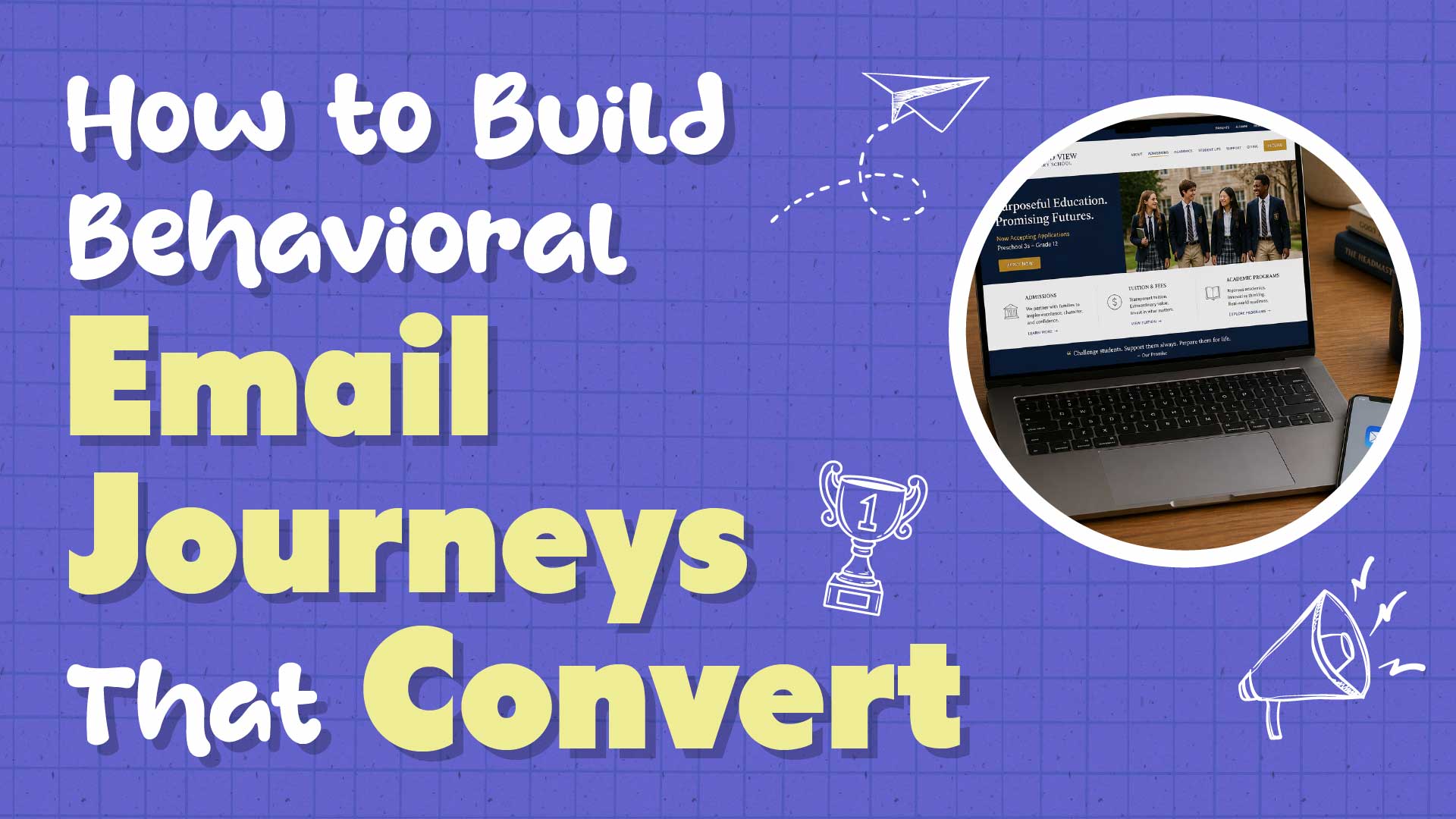
Your enrollment email strategy probably works like this: someone downloads your tuition guide on Tuesday, so your email automation sends them a welcome email on Wednesday. Three days later, a second email. Five days after that, a third.
But here's the problem: that family's real moment of interest might have been Thursday, when they spent 14 minutes on your financial aid page, then clicked through three STEM program profiles. By the time your automated third email lands, they've already moved on.
You're not actually responding to what families are doing. You're guessing when they care.
This is where behavioral triggers change everything. Instead of email timers, you're watching actual family behavior on your website. When a family hits a tuition or financial aid page for the second time in a week, an email arrives within hours; at the exact moment interest is hot. When a visitor clusters around STEM or athletics content, you send a program-specific nurture sequence. When a past prospect suddenly returns to your site, you reach out while they're actively considering your school again.
This approach works for private school marketing because it replaces guesswork with precision. You're not hoping someone is ready. You're responding to evidence that they are.

Written By: Adam Bennett | June 19, 2026
Adam is the president and founder of Cube Creative Design and specializes in private school marketing. Since starting the business in 2005, he has created individual relationships with clients in Western North Carolina and across the United States. He places great value on the needs, expectations, and goals of the client.
If you have been running the same pest control business for fifteen years, you might assume the multiple your neighbor got in 2021 will be waiting whenever you decide to sell. It will not. The market has tightened. The gap between an average $1.5 million pest control company and a premium one is no longer about luck or timing; it is about whether your business survives ninety days of institutional scrutiny without leaking value.
Cube Creative builds the marketing infrastructure that drives recurring revenue, lowers churn, and produces verifiable ROI for independent pest control companies. That same infrastructure shows up on a buyer's diligence checklist. Whether you are one year out or three, the work you do now to clean up revenue mix, software exports, and technician retention compounds into seven-figure differences at close.
This post hands you the same scoring criteria private equity rollups, regional acquirers, and strategic buyers like Rollins, Rentokil, and Anticimex actually use during diligence. Translation, in plain English: what the spreadsheet wizards are looking for, why they are looking for it, and how to plug the gaps before the clock starts.

Written By: Chad J. Treadway | June 18, 2026
Chad is a Partner and our Chief Smarketing Officer. He will help you survey your small business needs, educating you on your options before suggesting any solution. Chad is passionate about rural marketing in the United States and North Carolina. He also has several certifications through HubSpot to better assist you with your internet and inbound marketing.
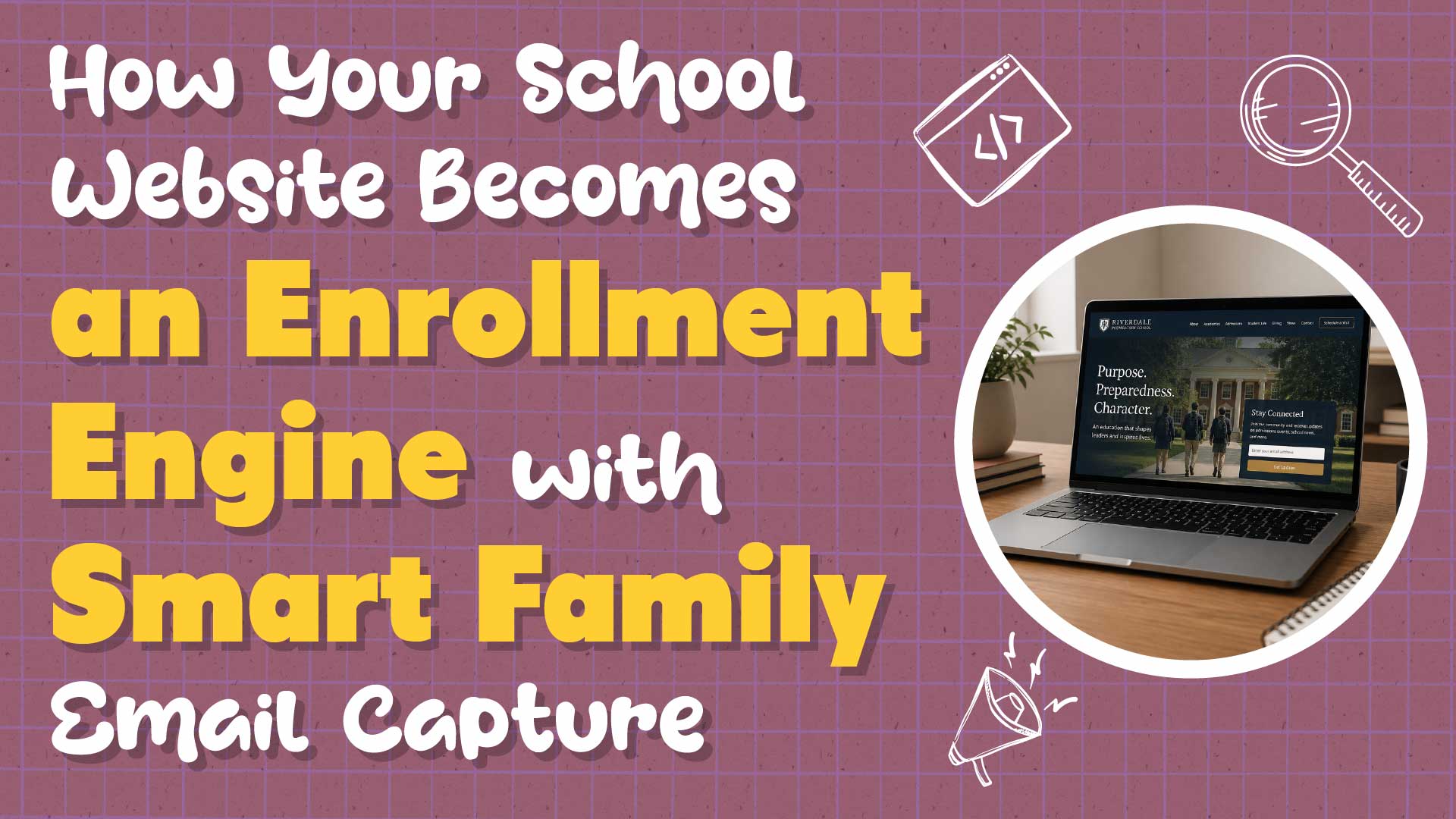
Your school website probably collects email addresses the way most websites do: a footer form that nobody notices, maybe a modal pop-up that appears at an awkward moment, and that's it. Then you wonder why your prospective family list grows at a crawl, and the families you do capture seem uninterested.
Here's the uncomfortable truth: you're not missing families. Your website is simply treating email capture as an afterthought instead of designing it as a system. When you build your website to actively identify high-intent visitors and invite them in with relevant offers, everything changes. You stop waiting for families to stumble onto your contact form and start turning qualified traffic into subscribers your admissions team can actually use.
you visit? Email
This isn't about bombardment or being pushy. It's about recognizing that private schools often leave massive opportunity on the table; families are already on your site, already interested, already telling you through their behavior exactly what matters to them. You just need to ask for the relationship at the right moment.
Written By: Adam Bennett | June 18, 2026
Adam is the president and founder of Cube Creative Design and specializes in private school marketing. Since starting the business in 2005, he has created individual relationships with clients in Western North Carolina and across the United States. He places great value on the needs, expectations, and goals of the client.
Here's where most marketing advice falls apart for growing pest control companies: it's written like every business is the same size. A blog post tells you to "spend 10% on marketing" without ever asking whether you're a one-truck operator or running 18 routes across three counties. That advice will steer you wrong in both directions.
What works at $500K actively hurts you at $2M. What works at $2M would bankrupt you at $500K. And the middle, the $1M and $1.5M zone where most independent pest control companies get stuck, is its own animal. The numbers shift, the channels shift, the staffing shifts, and the technology you absolutely need at one stage becomes overkill or insufficient at the next.
The good news: the milestones are predictable. The traps repeat. And once you can see them clearly, you stop guessing about whether to hire that office manager, switch CRMs, or pour more money into Google. You start making moves that fit the stage you're at.
This post maps the marketing decisions that matter at four specific revenue stops: $500K, $1M, $1.5M, and $2M. Spend percentages, channel mix, CRM stage, staffing, and the one number that tells you whether to keep your foot on the gas. It's grounded in real industry benchmarks, not vague "best practices," so you can hold it up against your own P&L and figure out where you actually stand.
Written By: Chad J. Treadway | June 17, 2026
Chad is a Partner and our Chief Smarketing Officer. He will help you survey your small business needs, educating you on your options before suggesting any solution. Chad is passionate about rural marketing in the United States and North Carolina. He also has several certifications through HubSpot to better assist you with your internet and inbound marketing.