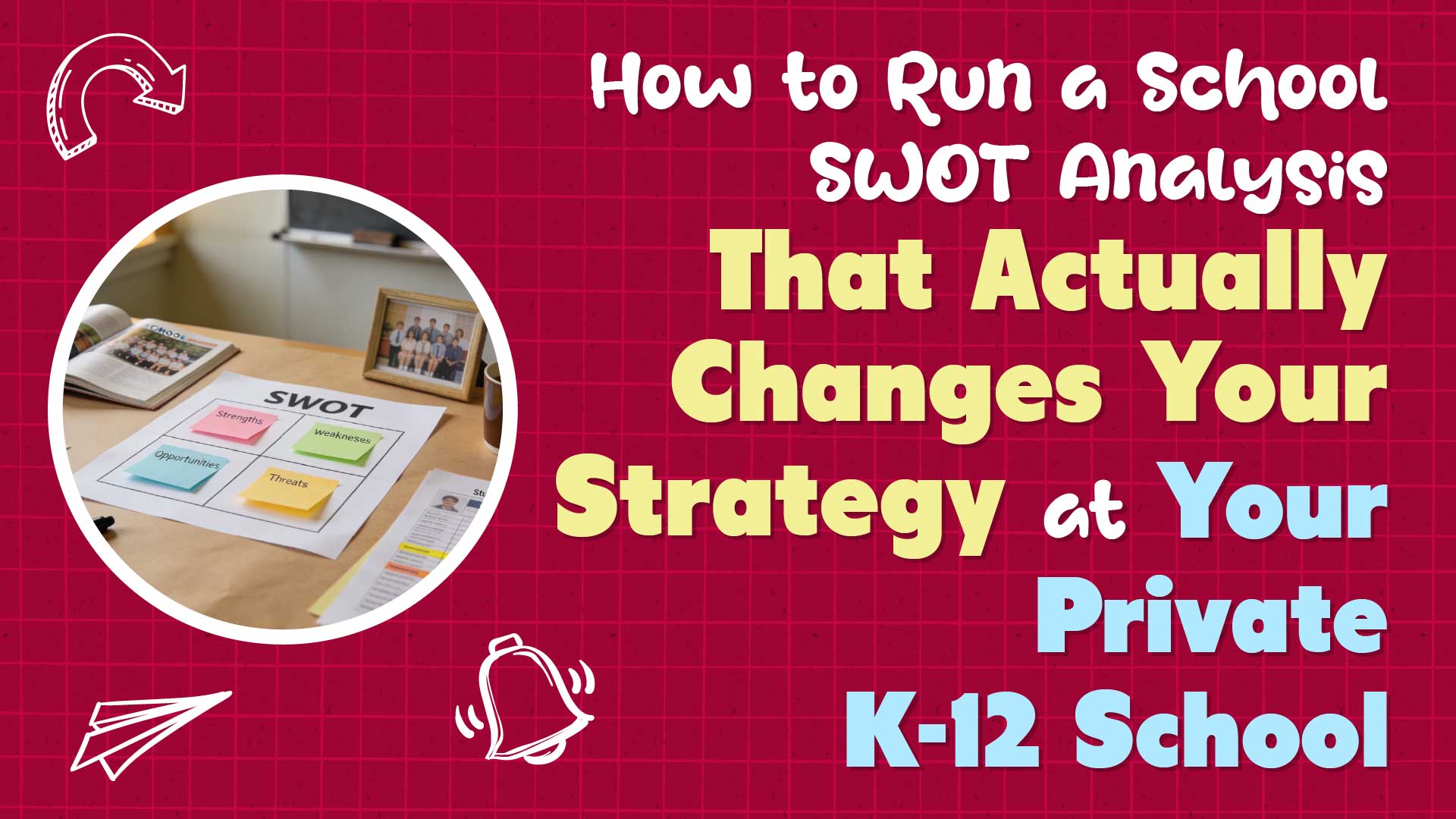
Your school probably has a strategic plan. It probably took months to produce, involved a consultant, and is currently sitting in a binder on a shelf in the development office. Nobody has opened it since the board approved it. That is not a strategy. That is a compliance document.
A real SWOT analysis is supposed to be the diagnostic that drives every enrollment and marketing decision you make for the next year. Most schools do not use it that way because most schools have never been shown how. They treat SWOT as a brainstorming exercise; it should be a stress test.
This guide is for the principal who is also the marketing director, the admissions counselor, and the person fixing the website at 10 PM. We work with private school leaders every week who tell us their last SWOT produced exactly zero decisions. Here is how to run one that does.

Written By: Adam Bennett | June 03, 2026
Adam is the president and founder of Cube Creative Design and specializes in private school marketing. Since starting the business in 2005, he has created individual relationships with clients in Western North Carolina and across the United States. He places great value on the needs, expectations, and goals of the client.
The pest control industry is having a moment. Demand is up, recurring revenue is healthy, and almost every truck on the road is busy. So why do so many independent owners in the 5-to-25 technician range feel like they're working harder every quarter and getting nowhere? Because the systems that worked at 3 trucks quietly stop working somewhere around 10, and nobody warns you when that line gets crossed. This post lays out the ten pest control business bottlenecks that hit almost every independent pest control company in this size range, in roughly the order they appear, with a way to self-diagnose and a sense of where the fix lives.
[Image suggestion: a pest control owner standing at a whiteboard with route stickers, looking at a tangled set of arrows; alt text: "Pest control owner mapping daily routes on a whiteboard at the dispatch ceiling."]

Written By: Chad J. Treadway | June 03, 2026
Chad is a Partner and our Chief Smarketing Officer. He will help you survey your small business needs, educating you on your options before suggesting any solution. Chad is passionate about rural marketing in the United States and North Carolina. He also has several certifications through HubSpot to better assist you with your internet and inbound marketing.
You don't hire pest control technicians on gut feel; you shouldn't, anyway. And yet most independent operators in the $400K to $2M range pull the trigger because they're tired, their existing techs are running late, or a few customers complained last week. That's not a financial signal — that's a bad week.
The all-in cost of the next technician is north of $80,000 in year one, and a route that doesn't pull its weight can drag your margin sideways for 12 straight months. That's expensive guesswork. The good news for pest control operators sweating this decision: it's a math problem, not a feelings problem. Here are the numbers that tell you when to hire, when to wait, and what to fix first.
Written By: Adam Bennett | June 02, 2026
Adam is the president and founder of Cube Creative Design and specializes in private school marketing. Since starting the business in 2005, he has created individual relationships with clients in Western North Carolina and across the United States. He places great value on the needs, expectations, and goals of the client.

If you run a home service company, you already know the pattern. Summer is chaos. Fall starts to cool off. And then somewhere around late October, you look at the schedule and wonder where everybody went. It is like your phone forgot how to ring.
Every home service business deals with some version of this. HVAC companies see it in spring and fall. Roofers feel it in winter. Landscapers watch it happen as soon as the first frost hits. The slow season is not a surprise. But for some reason, most business owners wait until they are staring at an empty calendar before they start doing something about it.
That is the wrong approach. The time to build your slow season marketing strategy is right now, while you are still busy. Think of it like changing the oil in your truck. You do not wait for the engine to seize. You do it on schedule so everything keeps running.
Written By: Chad J. Treadway | June 02, 2026
Chad is a Partner and our Chief Smarketing Officer. He will help you survey your small business needs, educating you on your options before suggesting any solution. Chad is passionate about rural marketing in the United States and North Carolina. He also has several certifications through HubSpot to better assist you with your internet and inbound marketing.