You're comparing Cube Creative Design and IronChess SEO. Good. You run a pest control company with somewhere between 11 and 30 trucks, your route board has good weeks and slow weeks, and two agencies are in your inbox promising the same thing: more calls, better rankings, your phone ringing. One of them is us. The other is IronChess SEO. You're trying to tell them apart before you write a check, and the websites aren't making it easy.
I'm Chad, and I run pest control marketing at Cube Creative Design. We work with pest control companies and nobody who sells homes, cars, or insurance. I have an obvious stake in which way you lean, so I'm going to tell you exactly where that bias sits, give you only verifiable facts about IronChess, and then hand you the questions that actually settle this.
Yes, I wrote this, and yes, I want your business. So does IronChess. The difference I'm betting on isn't that we want it more. It's how we earn it. There are things an agency can publish in plain sight: its prices, its results with real numbers, who owns the work when you leave. There are things it can keep behind a sales call. We publish ours. Where IronChess does not publish something, I'll say "not published" and leave it there. You're smart enough to draw a conclusion from a blank line.
If I skip the parts that make us look bad, nothing else on this page is worth reading. So I'll start with what makes IronChess appealing, because the appeal is real.

Written By: Chad J. Treadway | July 04, 2026
Chad is a Partner and our Chief Smarketing Officer. He will help you survey your small business needs, educating you on your options before suggesting any solution. Chad is passionate about rural marketing in the United States and North Carolina. He also has several certifications through HubSpot to better assist you with your internet and inbound marketing.
You are paying a marketing agency every month, and you genuinely cannot tell if it is working. The reports look busy. The numbers mostly go up. But the only number you actually care about, booked jobs, has been flat, and nobody wants to say so out loud. If that is where you are, you are not being paranoid. You are asking the right question, and most owners never ask it directly.
I run an agency that competes for pest control marketing work, so take this for what it is: an honest framework from someone on the inside. Plenty of agencies earn their fee. Plenty coast. The difference is not how polished the report looks. It is whether the work produces leads and booked jobs that you can trace back to the money you spent. This post gives you the metrics that matter, the red flags that should worry you, and the exact conversation to have before you decide to stay or go.
One fair warning before you judge anyone, including yourself, if you run marketing in-house. The channel changed in 2024, and results that dropped industry-wide are not automatically your agency's fault. The skill is telling "they stopped earning it" apart from "the whole field got harder." Both are real, and the rest of this guide helps you tell which one you are looking at.
Written By: Chad J. Treadway | July 03, 2026
Chad is a Partner and our Chief Smarketing Officer. He will help you survey your small business needs, educating you on your options before suggesting any solution. Chad is passionate about rural marketing in the United States and North Carolina. He also has several certifications through HubSpot to better assist you with your internet and inbound marketing.
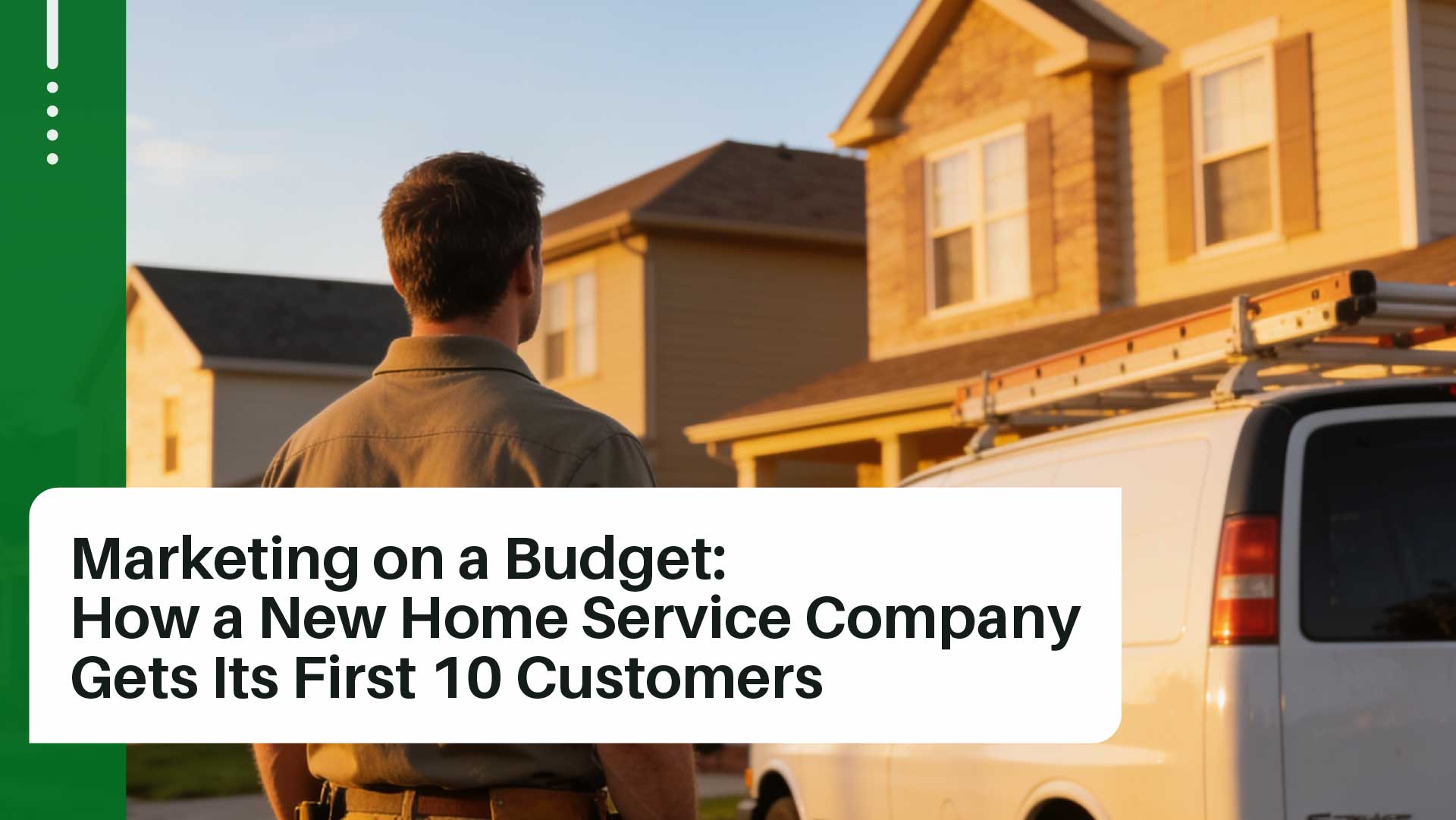
The big regional HVAC outfit across town runs a $15,000 monthly marketing budget. You have $200 and a work van with a coffee stain on the passenger seat. Sounds like a mismatch. It isn't. For a new home service company, the marketing budget matters far less than where you point it. We help home services companies sort the noise from the work that actually books jobs, and the honest truth is that your first 10 customers almost never come from paid ads.
If money is tight, you are in good company. Direct mail firm PostcardMania reported that 41% of small and midsize businesses spend less than $500 a month on advertising. The U.S. Small Business Administration says that it is fine for a while, because, as the Small Business Administration put it, "Tactics such as word-of-mouth, social media marketing and volunteering at community events are all virtually free ways to get your business in front of the public."
This is the $0 to $500 playbook: five neighborhood-level tactics that get a new contractor in front of local homeowners before you spend a dime on ads. Each one wins on proximity and trust, the two things the big company with the giant budget can't buy in your zip code.
Written By: Chad J. Treadway | July 03, 2026
Chad is a Partner and our Chief Smarketing Officer. He will help you survey your small business needs, educating you on your options before suggesting any solution. Chad is passionate about rural marketing in the United States and North Carolina. He also has several certifications through HubSpot to better assist you with your internet and inbound marketing.
Pest control marketing stops working for one of five reasons, and they usually show up together: the search channel changed under you, your website quietly stopped converting, your local presence went stale, your agency stopped earning its fee, or the math on your cost per lead stopped adding up. If you are asking why your pest control marketing is not working anymore, the answer is almost always one or more of those five, not bad luck.
Here is the good news buried in that. Marketing rarely breaks for some mysterious reason you will never figure out. It breaks for reasons you can name, and naming the reason is most of the fix. Your marketing used to work. The phone rang, the route board filled, and you did not spend much time wondering where the calls came from. Then it slowed down, either as a quiet quarter that turned into a quiet year or as a sudden drop nobody warned you about.
I run a marketing agency that works with pest control companies, and I want to be straight with you about where these numbers come from. They are not borrowed from some generic small business blog. In 2026, I evaluated 300 pest control companies across the country, putting their websites, SEO, and Google Business Profiles through the same review I run for clients. That audit is the closest thing our industry has to a mirror right now, and most owners do not love what they see in it. This guide walks through all five root causes, shows you how to tell which one is hitting you, and gives you the order to fix them.
Written By: Chad J. Treadway | July 01, 2026
Chad is a Partner and our Chief Smarketing Officer. He will help you survey your small business needs, educating you on your options before suggesting any solution. Chad is passionate about rural marketing in the United States and North Carolina. He also has several certifications through HubSpot to better assist you with your internet and inbound marketing.