The pest control industry has seen big growth and brought in strong revenue in recent years. According to Allied Market Research, the global pest control market was valued at $24.6 billion in 2022. It's projected to reach $42.5 billion worldwide by 2032, with a CAGR of 5.7% from 2023 to 2032. A few things drive this growth. Cities keep getting bigger. Public health worries keep rising. And more people now see why pest control matters.
Over the past decade, online marketing has caught on with pest control firms that want to reach more people and win new customers. Digital marketing tools like search engine optimization (SEO), pay-per-click advertising (PPC), social media marketing, and email marketing have proven they can bring in leads and get your brand seen.
But even with online marketing on the rise, traditional offline marketing techniques are making a comeback in pest control. Lots of shops are finding the worth of offline methods all over again. These methods have a few edges over their digital cousins. They let you target set areas, build trust face to face, and earn customer loyalty that lasts.
In this blog post, we'll look at offline marketing in pest control. We'll cover its perks and strategies. We'll also show how it can team up with your online marketing to build a full marketing approach that works.

Written By: Chad J. Treadway | May 22, 2024
Chad is our Chief Smarketing Officer. He will help you survey your small business needs, educating you on your options before suggesting any solution. Chad is passionate about rural marketing in the United States and North Carolina. He also has several certifications through HubSpot to better assist you with your internet and inbound marketing.
Are you tired of seeing your pest control company struggle to attract new customers and generate leads online? Do you feel like your website is lost in the vast sea of search results, failing to capture the attention of potential customers? If you’re nodding your yes head in frustration, you’re not alone. Many pest control companies face similar challenges when it comes to digital marketing.
In today’s digital age, online digital marketing has emerged as a powerful tool for pest control companies to expand their reach, connect with property owners, and drive growth. This dynamic field encompasses a variety of strategies and techniques designed to enhance brand visibility, engage target audiences, and generate meaningful results. From content marketing to search engine optimization (SEO), social media marketing (SMM), and more, pest control companies have a plethora of tools at their disposal to navigate the digital landscape successfully.
This blog post aims to delve into the process and strategies of online digital marketing while shedding light on its positive aspects and potential considerations. We will explore key elements such as content marketing, SEO, pay-per-click advertising (PPC), search engine marketing (SEM), social media marketing (SMM), email marketing, affiliate marketing, mobile marketing, and influencer marketing. Additionally, we will discuss the positive aspects that make digital marketing an attractive avenue for pest control companies, including wide reach, targeted advertising, cost-effectiveness, measurable results, enhanced customer engagement, flexibility, brand building, and diverse marketing options.
While digital marketing offers numerous advantages, it is crucial to acknowledge the potential negative aspects. Pest control companies must effectively navigate privacy concerns, ad blindness, information overload, increased competition, technical challenges, and negative feedback.
By understanding the strategies, positive aspects, and considerations of online digital marketing, pest control companies can leverage the power of digital channels to grow their brand, connect with customers, and achieve their business goals. Let’s embark on this journey into online digital marketing and unlock its potential for your pest control company.
Written By: Chad J. Treadway | May 15, 2024
Chad is our Chief Smarketing Officer. He will help you survey your small business needs, educating you on your options before suggesting any solution. Chad is passionate about rural marketing in the United States and North Carolina. He also has several certifications through HubSpot to better assist you with your internet and inbound marketing.
In the highly competitive world of pest control, your small businesses may struggle to make your mark in the vast digital landscape. Obviously, visibility is the lifeblood of your business, and in today's digital age, search engine rankings largely dictate visibility. The truth is, no matter how compelling your pest control solutions may be, if your website is buried deep in the search results, your business might as well be invisible. This is where search engine marketing (SEM) comes in as the exterminator's exterminator—a strategic tool that can root out the problem of invisibility and place your pest control company in the spotlight where it belongs.
In this comprehensive guide, we'll dive deep into the world of SEM and explore how it can revolutionize your pest control business. From understanding the basics to implementing advanced tactics, we'll provide you with actionable insights and real-world examples to help you dominate your local market and achieve online success.
Written By: Chad J. Treadway | May 13, 2024
Chad is our Chief Smarketing Officer. He will help you survey your small business needs, educating you on your options before suggesting any solution. Chad is passionate about rural marketing in the United States and North Carolina. He also has several certifications through HubSpot to better assist you with your internet and inbound marketing.
Imagine this: You’re Eden, the owner of Green Pest Elimination, a respected pest control company based in Asheville, NC, known for its eco-friendly approach and excellent customer service. You’ve spent months perfecting your website, showcasing your company’s unique offerings, and encouraging potential customers to choose your services. But there’s a problem: your website is painfully slow.
You’ve noticed visitors leaving your site before exploring all the fantastic content you’ve created. You’re worried your slow website is hurting your customer acquisition and damaging your company’s reputation. You’re not alone. In today’s fast-paced digital world, website speed matters more than ever.
As a pest control company owner or marketer, you know that your website is often the first point of contact for potential customers. Ensuring that your website looks great and loads quickly and smoothly is crucial. This is where page speed comes into play.
Page speed refers to the time it takes for a web page to load completely. It encompasses various factors, such as server response time, image optimization, and code efficiency. A fast-loading website provides a better user experience and significantly impacts your search engine rankings and overall online visibility.
Now, imagine a homeowner dealing with a pest infestation. They come across your website, eager to learn more about your services and solutions. However, if your site takes too long to load, they may become frustrated and leave before even exploring your content. On the other hand, a website that loads quickly and efficiently will keep visitors engaged and encourage them to discover what makes your pest control company unique.
In this post, I will explain why page speed matters, who needs to pay attention to it, and how you can improve your website’s performance to attract and retain more potential customers. Whether you’re a beginner looking to understand the basics or an experienced marketer seeking advanced techniques, this post has something for you. So, let’s get started on this journey to create a lightning-fast website that leaves a lasting impression on your potential customers!
Written By: Chad J. Treadway | May 08, 2024
Chad is our Chief Smarketing Officer. He will help you survey your small business needs, educating you on your options before suggesting any solution. Chad is passionate about rural marketing in the United States and North Carolina. He also has several certifications through HubSpot to better assist you with your internet and inbound marketing.
Are you a pest control company owner or marketer? If so, you know how crucial it is to have a strong online presence. And one critical factor in optimizing your website is its URL structure. In this guide, we’ll explore the best practices for crafting effective URLs tailored to the needs of pest control websites.
Are you losing potential customers because of poorly optimized URLs? In the competitive world of pest control, a well-structured website is essential for attracting and retaining clients – and it all starts with your URLs.
Written By: Chad J. Treadway | May 06, 2024
Chad is our Chief Smarketing Officer. He will help you survey your small business needs, educating you on your options before suggesting any solution. Chad is passionate about rural marketing in the United States and North Carolina. He also has several certifications through HubSpot to better assist you with your internet and inbound marketing.
As a pest control company owner or marketer, you know the importance of including relevant, high-quality photos on your blog articles, website, and social media posts. Photographs, illustrations, and other visuals can only enhance the appeal of your content.
Regarding content on the web, the general rule is that you should always include at least one image with each post. If your post is longer, you may want to have several.
Images and graphics are not only aesthetically appealing, but they also make your text more interesting to read. They can also assist you with search engine optimization (SEO).
Regarding image optimization for the web, there are three approaches to consider:
- Make your images look good.
- Make your images load quickly.
- Make your images easy for search engines to index.
Most articles on the subject focus on one of these elements or another; however, I will discuss all three in this post.
Written By: Chad J. Treadway | May 01, 2024
Chad is our Chief Smarketing Officer. He will help you survey your small business needs, educating you on your options before suggesting any solution. Chad is passionate about rural marketing in the United States and North Carolina. He also has several certifications through HubSpot to better assist you with your internet and inbound marketing.

Picture this: I'm about to share information that might catch you off guard. Are you ready for it?
Brace yourself for this surprising fact: Many consumers have a growing mistrust of businesses and corporations!
According to a January 2020 report by Marketing Charts, more than 3 out of 4 consumers in the US report a growing mistrust of businesses.
I know, I know. Shocking. However, somehow, pest control companies still create elaborate marketing campaigns that don’t involve their customers.
Now imagine a meeting at our fictional start-up pest control company, Bug Off Pest Control, based in Charlotte. Wendy, the founder and owner, gathered her team to come up with the best ideas for selling their services. I can hear it now.
“Oh, we should talk about our new, more eco-friendly products!”
“What if we get Wendy to talk about the benefits of our services?”
“Or, maybe we just increase our ad spend to get more traffic to the website!”

Some of these suggestions are solid tactics depending on the pest control niche. However, there is a monumental piece they’re not considering—the customer.
You know, the homeowners who hire pest control services and keep the company in business?
What if we were more reserved as pest control marketers and allowed those people to communicate with us more frequently? The possibilities would be endless.
Pest control companies have the opportunity to share their own stories and highlight their unique selling points to the world. The "About Us" page on your pest control website is the perfect place to showcase your history and humble origins. It's also a great platform to promote your brand's strengths to potential employees. However, suppose you're allocating your marketing budget to advertisements or flyers that list the top ten reasons a homeowner should select your service. In that case, you might be missing the mark.
There are countless reasons why customers should be the center of your pest control marketing strategy, and every year, the reasons get louder.
Written By: Chad J. Treadway | April 24, 2024
Chad is our Chief Smarketing Officer. He will help you survey your small business needs, educating you on your options before suggesting any solution. Chad is passionate about rural marketing in the United States and North Carolina. He also has several certifications through HubSpot to better assist you with your internet and inbound marketing.
In the world of pest control, the stakes are high, and the last thing you need is to lose valuable leads and appointments due to an underperforming website. Picture it: lost opportunities fluttering about like bats in the belfry, reminiscent of that chaotic scene from the 1989 Batman movie with Jack Nicholson and Michael Keaton. As a dedicated operator in the field, you understand the importance of a strong online presence. Without it, you're essentially leaving money on the table, watching your hard-earned growth seep away. But fear not because in this digital age, there are solutions to corral those elusive leads and guide them seamlessly into sales.
An effective digital presence is imperative for attracting more customers now and in the future. Through refreshing key elements around design, optimization, and technology integration—you can unlock your website’s revenue-generating potential.
This post will walk through essential strategies to overhaul your pest control site around three core pillars: Appealing visual design to capture attention, simplified booking flows to convert interest, and search engine optimization, ensuring you get found.
Written By: Chad J. Treadway | April 22, 2024
Chad is our Chief Smarketing Officer. He will help you survey your small business needs, educating you on your options before suggesting any solution. Chad is passionate about rural marketing in the United States and North Carolina. He also has several certifications through HubSpot to better assist you with your internet and inbound marketing.

Opening a pest control company involves major upfront investments - licensing, equipment, hiring, and more. But how can you expect to stay in business without a steady flow of new customers? Many pest control companies fail to plan for critical marketing expenses needed to transform an unknown startup into an established neighborhood provider.
Are you struggling to attract new clients without overextending your marketing budget? Do you find it challenging to determine the right marketing investment to fuel your pest control company's growth goals? You're not alone. Setting the ideal budget to achieve sustainable growth requires custom insights into your business stage, offerings, and market.

Written By: Adam Bennett | March 27, 2024
Adam is the president and founder of Cube Creative Design and specializes in private school marketing. Since starting the business in 2005, he has created individual relationships with clients in Western North Carolina and across the United States. He places great value on the needs, expectations, and goals of the client.
Picture this – a homeowner in Charlotte discovers a termite infestation, a restaurant owner in Hickory battles cockroaches, a vintage boutique store in Asheville struggles with pesky rodents, and a hotel in Raleigh faces a persistent bed bug problem. Each scenario underscores the universal need for effective pest control solutions.
This begs the question of how they find a solution to their problem. Chances are they are going to the web to search for a solution. They may be presented with some DIY solutions and a list of pest control websites.
However, many pest control businesses have websites that just aren’t generating leads and sales.
Therefore, tell me if these sound familiar to you:
- “Our website just isn’t generating leads.”
- “We get calls, but visitors aren’t converting online.”
- “People can’t seem to find us in searches.”
Do any of those website problems sound familiar? If you run a pest control company, having an effective online presence is imperative for attracting more customers in today’s digital age. According to Adobe, 38% of users will stop engaging with a site if it is unattractive in layout or imagery, and 39% will stop engaging if the content takes too long to load. (Source: HubSpot)
Through consulting with pest control companies and small businesses across the south, I’ve found the websites that convert visitors best and win more business tend to have three key elements: an appealing design, streamlined online communication, and strong search engine optimization (SEO).
In this guide, I will walk through the essential strategies and best practices pest control businesses should implement on their website to start driving more calls, form fills, and sales. By focusing on crafting the optimal design, online booking process, and SEO foundation, you, too, can unlock the revenue-generating potential of your digital presence.
Written By: Chad J. Treadway | March 20, 2024
Chad is our Chief Smarketing Officer. He will help you survey your small business needs, educating you on your options before suggesting any solution. Chad is passionate about rural marketing in the United States and North Carolina. He also has several certifications through HubSpot to better assist you with your internet and inbound marketing.
For pest control companies, customer complaints and service failures can be a real pain. Upset customers can spread a bad story fast and drive others away. But when things go wrong, the “Service Recovery Paradox” gives you a chance to do more than fix the problem. You can make loyalty stronger.
The Service Recovery Paradox (SRP) says that when companies handle service failures and complaints well, customer satisfaction and loyalty can climb higher than they were before the failure. It's a surprising idea, and researchers still debate it. A 2007 meta-analysis in the Journal of Service Research found that strong recovery lifted customer satisfaction on average, but it found no clear effect on repurchase intent or word of mouth. So great service recovery can lead to better customer views and stronger ties. It just isn't a sure thing. Saving a tough spot lets pest control providers show they're serious about good service. When you fix issues fast, with care, and in ways that beat what the customer hoped for, thanks can replace frustration. The bond between customer and provider can get stronger.
For pest control companies, SRP is a big chance to turn service problems into moments that build customer loyalty. Let's look at how service recovery drives loyalty, and the ways you can put this effect to work.
Written By: Chad J. Treadway | March 13, 2024
Chad is our Chief Smarketing Officer. He will help you survey your small business needs, educating you on your options before suggesting any solution. Chad is passionate about rural marketing in the United States and North Carolina. He also has several certifications through HubSpot to better assist you with your internet and inbound marketing.
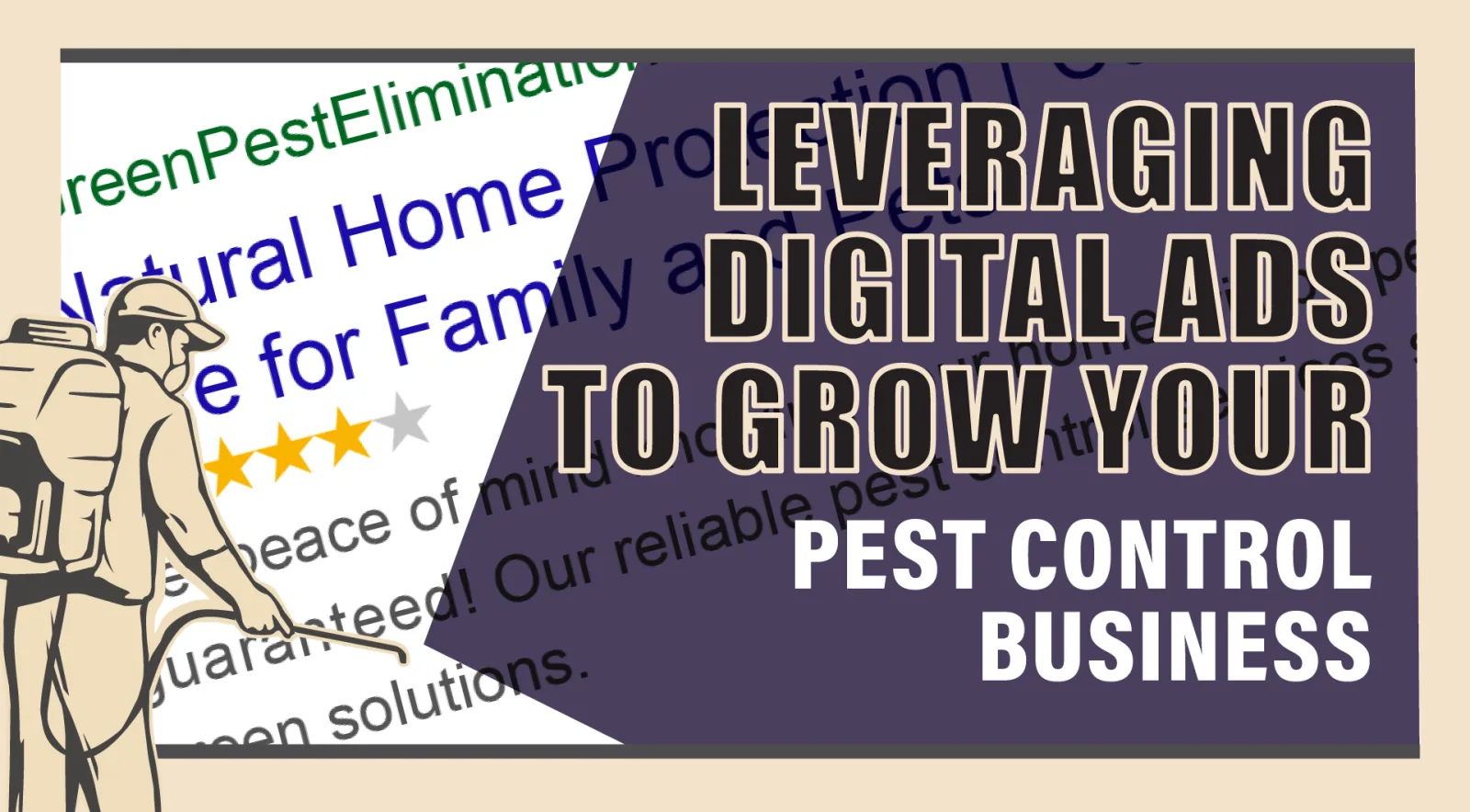
In the modern business landscape, digital advertising has become not just an advantage but a necessity. This is particularly true for local service businesses such as pest control. With consumers increasingly turning to online search for their needs, having a strong digital presence can make or break a business.
Digital advertising offers a wealth of benefits for pest control businesses. Effective digital ads can help attract more customers, increase your pest control brand visibility, and ultimately boost profits. In this guide, I'll be sharing tips and best practices on how to create compelling digital ads that resonate with your target audience and set you apart from your competitors.
So, let's dive in and discover how you can supercharge your pest control business through effective digital advertising.

Written By: Hannah Kilpatrick | March 13, 2024
Hannah Kilpatrick Cube Creative DesignHannah Kilpatrick graduated from Western Carolina University in 2021 with a Bachelor of Science in Communication with a Minor in Marketing and a Concentration in Public Relations. She has been around social media since its creation. (Meaning, she was in the first grade when Facebook became available to the general public.) As our very own professional Gen-Z, Hannah is a whiz when it comes to social media creation and paid advertising.